Using your drilling and sampling data, the underground mass is transformed into a defined volume with boundaries in a 3D digital environment. The boundaries of this volume constitute the solid model (wireframe); we obtain a block model by filling it with rectangular prisms representing the rock mass inside. By assigning data to each prism, we color-code the block model, enabling us to visualize the location and quality of the ore, and perform calculations. If we can estimate the value of each prism within the solid volume, we can also estimate the total resource quantity, which is the sum of these values. You can report these calculations and present them to inform investors.
Since your model is digitally positioned on a specific coordinate system, you can determine the tonnage and grade of ore you can extract from any given point within the model.
Before transitioning your exploration project into an operation, you can run simulations to determine whether it will cover your expenses and yield the desired profit and profit margin. Your resource model is the primary foundation for all studies, such as pre-feasibility, feasibility, pit and process design, and the Life of Mine (LOM) plan.
By completing all your planning in a 3D environment, you can transition to operations exactly as desired with underground or open-pit plans using mapping and in-situ marking tools (GPS, theodolite, etc.), budget your production for any desired term, and conduct reconciliation and control during production.
You can generate models to foresee various parameters regarding geotechnics, slope and tunnel stability, mineral processing, and metallurgy prior to pit production or feasibility studies.
You can utilize modeling to calculate natural stone, marble, and industrial raw material resources and reserves, and make the most accurate estimates regarding quality and block values.
You can find detailed information on modeling and reporting in our recent articles listed below.







Using geostatistical methods, you can assign all numeric or alphanumeric data obtained from drill core logs and sampling results to the blocks within the solid volume, enabling numerical or alphanumeric calculations for tonnage, grade, quality, rock mass quality, etc. With reliably acquired drilling and sampling data, you can achieve your goals by modeling data and making near-reality estimates on numerous aspects, including:
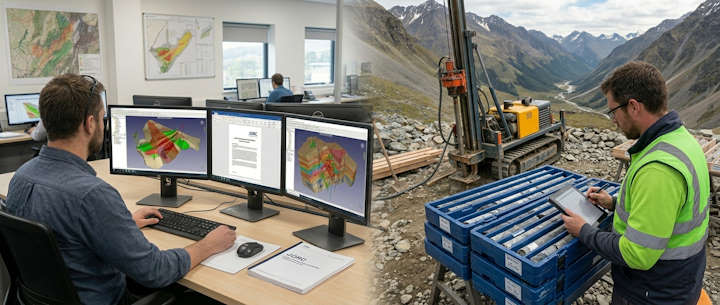
Reliable data means a reputable report. Maintaining quality control and standards while generating data during exploration activities requires strict discipline and meticulousness.
When you want to obtain a model for the mineralization identified in your license area or a specific aspect of your operation, the following serve as the fundamental basis for modeling:
If production has taken place in the project's history:
In addition to these, if possible:
In short, if all data with known spatial coordinates gathered throughout the exploration activities are taken into account, the resulting model will closely approximate reality.
Considering all these points and circling back, establishing a database and reliably expanding this wealth of information in a multi-employee project requires a corporate culture. In line with your initial corporate strategy, you must establish your data acquisition criteria and Quality Assurance / Quality Control (QA/QC) protocols and maintain them consistently. These protocols will determine the level of credibility of the information you disclose or the reports generated. If the protocols you initially establish do not comply with the criteria for presenting reliable data or reporting (JORC, UMREK, NI 43-101, etc.) that you aim for, you will face time and financial losses to rectify these deficiencies. Therefore, it is highly recommended to start the exploration project by establishing a clear foundation in line with your objectives.
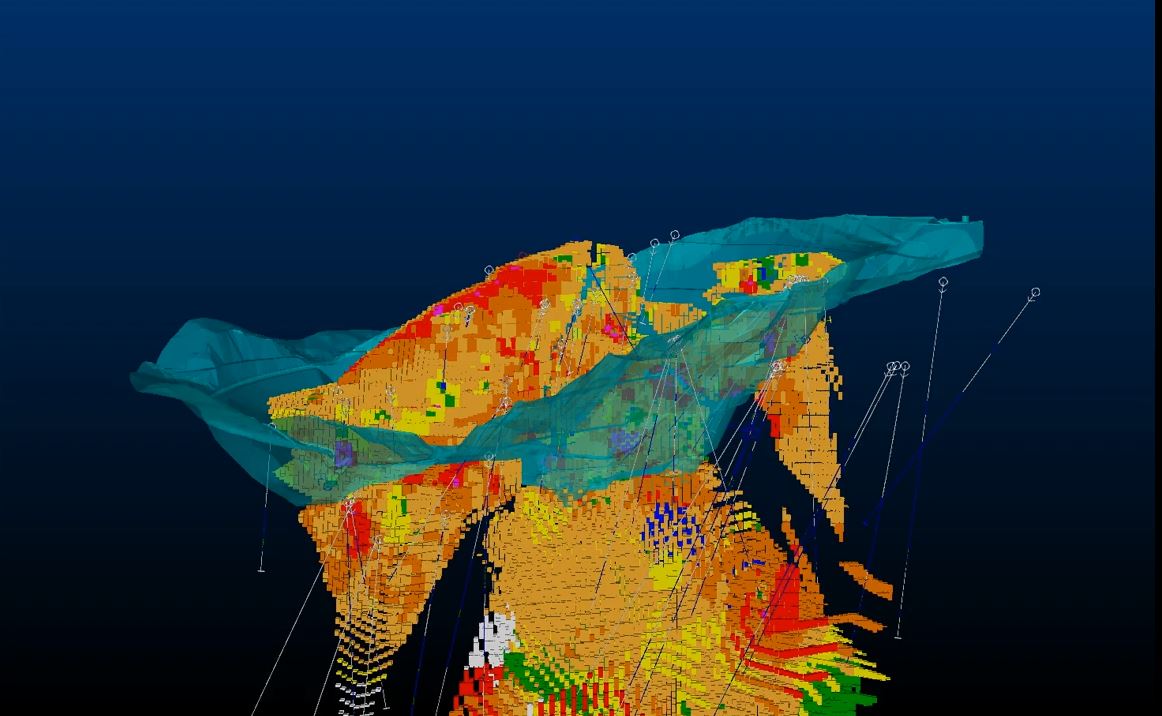
In a solid model populated with blocks, the nature of the mineral emplacement must be resolved to determine the quality/grade value to be assigned to each block. If spatial analysis is conducted using the most appropriate direction and function compatible with this resolution, and statistical methods are selected and applied accordingly, a model closest to reality can be generated. When the goal is to simulate reality, solid modeling (wireframing) defines the boundaries, whereas geostatistics allows us to estimate the spatial variability within those boundaries. This enables us to make estimations about mineralization across square kilometers of area at various elevations, using drill cores only 5–10 cm in diameter.
A thorough understanding of the genesis of the mineralization and its contextualization within geological models is crucial for an accurate estimation. Computer software typically incorporates "Ordinary Kriging" and Inverse Distance Weighting (IDW) interpolation methods as built-in features. In the Kriging method, determining the variogram in different spatial directions relies heavily on the geologist's interpretation. Furthermore, if you have a strong command of the mineralization genesis, you can incorporate anisotropy into your geostatistical formulas to obtain values that most closely reflect nature. In conclusion, setting aside formulas and calculations; the mineralization concept put forward by the geologist forms the foundation of the entire process, and geostatistics ensures this concept is approximated to reality.
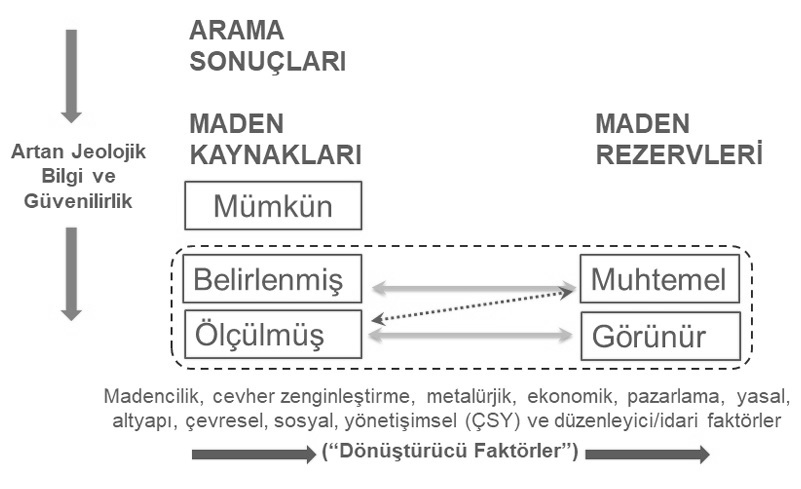
Transparent and comprehensive reports regarding mineral resources and mining projects, prepared by Competent/Qualified Persons, are reliable.
In the mining world, reports complying with standards such as JORC or its equivalents (UMREK, NI 43-101, PERC, etc.), which eliminate subjective interpretations and ensure an evaluation based on objective data, are considered reliable. These reports must be signed by Competent Persons who meet the criteria established by the relevant national authorities.
The most common standards gathered under the umbrella of CRIRSCO (Committee for Mineral Reserves International Reporting Standards), which are largely compatible with each other, are:
You may find it useful to review these:
https://gmrtc.com/repfraudtr/
https://gmrtc.com/repfrauden/
All codes within this framework utilize the same "Resource" and "Reserve" classification logic as JORC. An UMREK report prepared for a mining concession can be read by an investor in Australia or a bank in Canada with the same level of confidence as JORC or NI 43-101. The difference between them lies not in the content, but rather in which country's legal and financial regulations (stock exchange) the report will be submitted to.
Sometimes even mining professionals struggle when reading these highly technical reports. It is highly recommended to seek consultancy when evaluating reports prior to making license acquisition or divestment decisions.

If listing your company on the stock exchange is among your plans, or if you already have an Initial Public Offering (IPO), you may be subject to specific regulations required by the relevant institutional directives when it comes to public disclosure. As a guarantee that the data you present is not misleading, a necessity may arise for the methods of data acquisition and the reporting individuals and institutions to meet specific standards. Based on the principles of transparency, consistency of all information, and domain expertise, your resources and production may need to be periodically reported by impartial experts who possess the requisite competency and are subject to audit and sanctions. This reporting will require the signatures of Competent/Qualified Persons registered with reputable organizations across multiple disciplines. Bear in mind that data calculated from your model will be utilized under the resource and production headings in the report, and that minimum compliance with QA/QC elements must be ensured throughout the entire mining production process, starting from the exploration phases, for the creation of your ore model. In summary, the necessity for control and assurance standards across multiple chained earth science steps will emerge in order to reach the final product, the report.
Even if you have no affiliation with the stock exchange or an IPO, implementing the audits and standards mentioned in the above note from the very beginning will positively impact your mining investments and decisions. During the acquisition and divestment stages of mining projects, the credibility of data obtained and reports generated under these standards is at the highest level across the market.
Contact your investment advisor for all detailed information regarding your company's IPO matters and requirements.

As GMRTC, we can:
You can contact us for your modeling and reporting needs.

Follow our website and social media accounts to stay informed about all our mining and geology training programs.
You can contact us for corporate group training requests for your company personnel within the scope of your projects or operations.
You can get a quote by using our communication channels for external auditing (exploration-production-modeling-reporting-corporate mining), investment initiation, and continuous consultancy tailored to your specific needs.