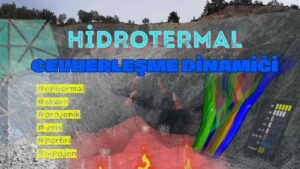
HYDROTHERMAL MINERALIZATION DYNAMICS: THE ORIGIN OF MINERALIZATION
Hydrothermal mineralization systems arise from deep-seated tectonic activity and magmatic intrusions that drive complex fluid circulation and phase formations within the Earth's crust. Understanding the genesis of hypogene deposits, including porphyry, VMS, and epithermal systems, is critical for accurate resource estimation and mitigating high-risk investment decisions. This fundamental knowledge serves as the essential technical framework for solving complex challenges in mineral exploration, deposit modeling, and metallurgical processing.
As the name suggests, hydrothermal mineralization refers to accumulations of minerals deposited by hot fluids rising from an intrusive source, dissolving metals at varying concentrations.
From skarn to epithermal systems, orogenic to volcanogenic massive sulfide (VMS) deposits, and both vein-type and disseminated formations — these systems universally require two critical elements: tectonic activity and a heat source.
Depending on the style of mineralization, tectonic mobility occurs at variable depths and generally aligns regionally with the associated intrusive rocks a few kilometers below the surface.
2. Environment and Hot Water Circulation
Depending on the type of mineralization, mixtures of meteoric or magmatic waters and volatile compounds, in varying concentrations, dissolve ore minerals from the primary source and transport them to the mineralization chamber.
Magmatic bodies located several kilometers deep may dissolve metals through interaction with groundwater systems that sometimes span hundreds of square kilometers.
The ore deposits form as the hot fluids — even those containing trace amounts of metals — circulate over thousands to hundreds of thousands of years, depending on the scale of the deposit.
Fractures formed by prevailing tectonic activity, bedding planes, or permeable spaces within host rocks serve as reservoirs for mineralization.
When faulting and associated fracturing begin to develop, the metal-rich fluids mobilize and progressively clog their flow channels with ore and gangue minerals.
With continued tectonic activity, new fractures within pre-existing mineralized phases or voids along the developing fault path accommodate subsequent mineralizing phases.
Additionally, depending on the location of the main channel or fracture system forming the ore body, different types of alteration may develop as halos in the surrounding rocks as fluid flow continues.
3. Development of Mineralization Phases
During circulation, changes in fluid discharge rate, “pH” levels, and hence metal dissolution capacity over time will manifest as distinct mineralizing phases.
As mineralization continues, previously clogged channels may re-open under ongoing fault-related deformation, allowing new phases to develop.
Hydrothermal activity may also create breccias by fracturing pre-existing mineralized zones or host rocks with the aid of fault movement, causing deposition or solidification of minerals in certain segments.
These breccias may then be cemented with gangue and ore minerals, forming subsequent mineralization phases.
The overprinting process continues until the structural deformation and fluid activity cease, leading to periodic and compositionally varied accumulations within the ore body.
Near the end of faulting and fracturing, more texturally uniform and elongated mineral bands with relatively lower grades may develop.
As the system depletes its ability to dissolve metals from the primary source, even if hydrothermal activity continues, the resulting phases are likely to be lower-grade or barren.
4. Why Understanding the Origin of Mineralization Matters
Determining how much of the ore body a sample actually represents is crucial for evaluating the potential economic return of a mineral deposit.
Sampling in mineral exploration must be conducted as accurately as possible — otherwise, analytical results may be misleading, and it might be too late when errors are detected.
In such cases, you may overlook mineral resources with economic potential or overestimate grades, leading to poor investment decisions.
Defining the mineralization concept and proceeding with well-informed estimations contributes significantly to solving critical challenges in areas such as mine production, stockpile management, processing, and metallurgy.