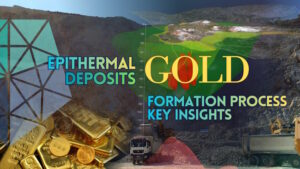
Epithermal gold deposits form when hydrothermal activity at shallow depths deposits precious metals like gold and silver into structural voids such as faults and fractures. First defined in 1894 by Waldemar Lindgren, these systems hold a critical place in economic geology and mineral exploration processes. The analysis of alteration models unique to these deposits forms the basis for accurate mapping of mineralization zones and increasing exploration success.
With rising gold prices and advancing technology, the allure of these deposits has increased. As a result of heightened interest, many weathered and exposed deposits have been discovered. Considering the risk involved in exploring undiscovered or partially eroded ancient hydrothermal systems, evaluating all clues becomes crucial. In this piece, we examine the most crucial of the indicative criteria for hydrothermal deposits: the alteration model. We delve into alteration types such as argillic and propylitic, discussing field recognition.
1. At some time after the Oligocene... (Or today in Yellowstone)
Relationship between hot springs, geysers and the faults that feed them.
2. Water flowing underground along shallow faults can emerge at the surface from specific points where they converge. Not all fluids reaching the surface need to carry metals.
Waters with temperatures ranging from 50 to 350 degrees Celsius, typically with a pH level between 5-7, carry trace amounts of precious metals like gold and silver, along with other base metals in solution.
When these waters reach the surface, they can have a pH value ranging from 1 to 10.
Acidic hot waters carrying metals deposit silica, carbonate, and metals along the faults they pass through, penetrating the surrounding rock.
Masses with varying geometries left behind in faults or open spaces typically constitute ore bodies.
The alteration resulting from the passage of hot waters, albeit slight, due to acidity and temperature, leads to alteration.
3. Let's come to the present: How do we find eroded, transported, and covered ore bodies?
Alteration masses, whether indicative of mineralization or not, may be partially or completely eroded.
If you see ore bodies on the surface due to erosion, you are lucky; retrieving the rest is relatively easy. However, until now, someone have identified the majority of these.
In the eroded part, you may see traces of “hydrothermal activity” that could potentially lead to mineralization. Being lucky is not enough here.
It’s important to recognize the alteration traces you see. The alteration indicators you identify will indicate where in the system you are.
You should look for these indicators in all lithology intersections from drilling and fieldwork.
With this information, you will determine what type of mineralization to search for, where, and how, shaping your exploration activities.
Therefore, it’s crucial to recognize these indicators well, interpret them, or show these drillings and samples to someone who does.
4. Back to start from the end: Let's follow the alteration in an ore body produced in a mine.
Alteration develops in halos around open-space fillings such as faults and fractures created by hydrothermal activity.
These halos are significantly broader than the area constituting the ore body. Recognize the alteration halos using the “Buchanan, 1981” model, which presents a typical section for epithermal mineralization.
Finding such a section showing epithermal mineralization and the surrounding alteration is quite challenging. It’s only possible to observe this in exposed mine faces if they are washed and moist.
We can clearly see the alteration halos and their comparison with the model from a cross-section perpendicular to the average extension of an epithermal mineralization in the photo.
Based on this section, we can estimate the amount of eroded mass due to hydrothermal activity until today.
Metal production (ROM) at an “economic” level of mineralization was achieved at the specified valuable metal levels.
5. Hot waters resisting gravity choose the easiest way they find: open spaces, faults, and fractures.
Although the path they choose is absolutely opposite to gravity and perpendicular to sea level in thought, during their formation, they gradually fill these voids.
Existing vein masses will undergo numerous deformations until today; their positions will be different from their initial positions.
By properly tracking alteration, you can better approximate your drilling plans for vein continuity. Otherwise, you may make incorrect decisions like stopping your drillings where the vein hasn’t been closed.
6. If we provide an approach for a relative geothermometer of hydrothermal flow for the shape, we can talk about an inclined extension similar to a quarter circle.
In this way, we can estimate the approximate direction of hydrothermal water flow necessary for vein formation, hence the direction of valuable metal phases.
Especially within alteration zones, settling metals won’t provide continuity. Therefore, you must correctly interpret and model the ores you intersect with drilling or production.
Identifying alteration zones before modeling or planning of development drillholes can make a significant difference.
For this, you must photograph your drill cores as cleanly and clearly as possible and keep them readily available for an active comparison during modeling.
You must properly map out the alteration zones in the field and, if possible, utilize mineral spectrometry studies in the field or office.
Resource model or grade control model is not a mineralization model. It’s a part of the mineralization that meets the criteria you desire.
Focusing only on where you will mine ore instead of planning to drill to determine the origin of the deposit is better.
Don’t disregard the utopian dreams of geologists; they will become essential when you realize the stockpiles are nearing depletion.
“After deciding by saying ‘I understood nature’ after being informed, you will see that the result is not so. Prefer approaching rather than understanding, nature is more perfect than you think.”