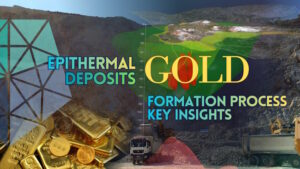
EPITHERMAL GOLD DEPOSITS: FORMATION PROCESS AND FUNDAMENTALS
Epithermal gold deposits are highly sought after for their high-grade mineralization and operational flexibility, offering rapid economic returns in volatile markets. As near-surface resources deplete, the industry is shifting toward deep exploration programs that rely heavily on advanced expertise and conceptual modeling. Understanding 3D geological indicators and hydrothermal processes is essential for successfully navigating the complexities of these high-value mineral systems.
1. Importance of Epithermal Deposits in Gold Production
Although country-level gold production has been clearly reported for 2024, the proportion derived from epithermal deposits is not specified in official sources. Geological literature and field studies estimate this share at approximately 20–30%. Due to their high grades and near-surface occurrence, epithermal deposits reduce operating costs and allow the economically viable extraction of precious metals, particularly in conjunction with silver, making them highly attractive and strategic targets for mining companies.
2. Epithermal Is a Genetic Class, Not a Depth Term
Epithermal systems form from hydrothermal fluids linked to magmatic heat sources, typically at shallow depths (<1–1.5 km). Therefore, not every shallow gold deposit is epithermal; a magmatic–hydrothermal origin is a prerequisite.
3. Epithermal Systems Are Open Hydrogeochemical Environments
The intensive influx of meteoric water continually modifies fluid composition, causing abrupt fluctuations in temperature, pH, and redox conditions. Consequently, mineralization is both spatially and temporally heterogeneous, with sharp variations in grade and mineralogy even within a single vein.
4. Boiling Is the Primary Gold Precipitation Mechanism
Hydrothermal boiling due to pressure drop causes H₂S degassing and the breakdown of Au–bisulfide complexes. This results in rapid, localized gold precipitation, explaining why enrichment zones in epithermal systems are generally narrow and associated with sharp textural boundaries.
5. Low-Sulfidation Epithermals Can Host Highest and Most Homogeneous Gold Grades
Adularia–quartz veins provide ideal environments for high-grade Au–Ag mineralization. Silicification, adularia, sericite, and chlorite alteration are typical. Low-sulfidation systems are not weak; in fact, they often host the highest local grades of mineralization.
6. High-Sulfidation Epithermals Reflect the Magma’s Chemical Signature
Magmatic gases rich in SO₂ and HCl produce extremely acidic fluids that intensely alter host rocks, forming vuggy silica zones and advanced argillic minerals such as alunite and jarosite. These alteration types are characteristic indicators of high-sulfidation systems.
7. Definition of Low vs. High Sulfidation
The terms “low” and “high” refer to the degree of sulfidation in the system—that is, the intensity of fluid–rock sulfur interactions. Low-sulfidation fluids are neutral to mildly alkaline, producing limited sulfur–rock interaction and forming adularia–quartz veins with low-sulfidation mineral assemblages. High-sulfidation fluids are extremely acidic due to magmatic gas input, causing intense sulfidation reactions and formation of advanced argillic alteration with vuggy silica zones.
8. Faults Are Not Just Fluid Pathways but Mineralization Triggers
Fault zones act as reactive regions where pressure, temperature, and redox conditions change abruptly. Boiling or mixing of fluids in these zones triggers metal precipitation. The richest mineralization is often concentrated along these transitional zones.
In epithermal systems, Au–Ag generally concentrates at shallow to intermediate levels, while base metals (Pb–Zn–Cu) are found deeper. This vertical metal zoning reflects the rapid evolution of the system and the dynamic pressure–temperature conditions of the fluids.
10. Textural zoning is relative, and its interpretation is limited by the interpreter’s experience
Banded quartz, colloform textures, cavity fillings, and breccias are common. However, these textures are often products of localized processes. Boiling, fluid mixing, or fault-controlled pressure fluctuations enhance textural diversity. Thus, textural zoning does not always directly correspond to the overall system evolution and requires contextual interpretation.
11. Alteration Zones Map the System, Not the Ore
Silicification, argillic (illite, kaolinite), propylitic (chlorite, epidote, carbonate), and advanced argillic (alunite, dickite, pyrophyllite) zones represent the architecture of the hydrothermal system rather than the ore itself. Misinterpretation of these zones can lead to incorrect targeting in exploration.
12. Fluid Inclusions Provide Critical Clues
Boiling, fluid mixing, and salinity variations are directly recorded in fluid inclusions. These analyses are among the most powerful tools to understand precipitation mechanisms and the evolution of mineralization.
13. Epithermal Systems Are Often Near Volcanic Centers but Asymmetric
Alteration types and metal distribution change significantly with distance from volcanic centers. Ignoring this asymmetry can lead to incorrect exploration targeting. Systems may be associated with volcanic centers but display strong lateral variations.
14. Argillic Alteration Is Not Always a Mineralization Indicator
Argillic zones can cover extensive areas, whereas mineralization generally concentrates in narrow zones associated with silicification and adularia. Focusing solely on argillic alteration can therefore be misleading.
15. Epithermal Systems Are Genetically Linked to Porphyry Systems
Many epithermal deposits represent the upper levels of deeper porphyry Cu–Au systems. Correctly interpreting this relationship is critical for regional exploration strategy. Porphyry–epithermal transition zones can display sharp changes in metal distribution.
16. Epithermal Systems Are Geologically Short-Lived
Most epithermal deposits form over tens of thousands to hundreds of thousands of years. This rapid evolution explains sharp metal zoning and textural diversity. Systems close quickly, completing mineralization in a geologically brief period.
17. Orogenic and Carlin-Type Deposits Are Not Epithermal
Although both can occur at shallow crustal levels, they are not genetically epithermal. Orogenic gold deposits form from metamorphogenic fluids released during prograde metamorphism and are typically structurally controlled by major shear zones. In contrast, Carlin-type deposits are sediment-hosted systems characterized by disseminated, sub-micron “invisible” gold structurally bound within arsenic-rich pyrite.
18. Orogenic Gold Is a Product of Metamorphic Fluids
Orogenic gold deposits form from metamorphic fluids released during prograde metamorphism rather than from magmatic sources. These fluids typically operate at mesothermal conditions (≈200–400 °C, 1.5–6 km depth), and although the resulting mineralization may share structural similarities with epithermal systems, the deposits are genetically distinct. While most orogenic gold deposits are mesothermal, the term “mesothermal” refers to the temperature and depth of formation, not a separate deposit type; therefore, orogenic and mesothermal are related but not identical concepts.
In Carlin-type deposits, gold occurs not as visible native gold but as sub-micron, lattice-bound particles within arsenic-rich pyrite. Although the onset of mineralization may be structurally controlled, it is generally governed by the permeability characteristics of the host rock and occurs in a disseminated form, without association with open-space fillings, boiling, or prominent vein systems. While carbonate host rocks can buffer hydrothermal fluids and limit the development of strong silicic or argillic alteration, alteration zones reflecting the chemistry of the host rock can still be traced.
20. VMS Deposits Are Not Epithermal but Can Be Confused
Volcanogenic massive sulfide deposits form in submarine volcanic environments through rapid mixing of hydrothermal fluids with seawater. Although the heat source is magmatic, precipitation occurs via submarine exhalative mechanisms. “Black smoker” and “white smoker” chimneys are typical examples.
21. Misclassification Directly Leads to Failed Exploration
Assuming a non-epithermal system is epithermal can result in incorrect geochemistry, flawed alteration models, and wasted drilling efforts.